
Historic Properties Will Welcome Visitors on Talbot County Tour, May 9
- Press Releases
-
Mar 23
-
6 min read
- Share post
In celebration of America 250, visitors taking the TALBOT COUNTY TOUR of the MARYLAND HOUSE & GARDEN PILGRIMAGE will experience an array of stellar homes, gardens and nationally significant historic sites on Saturday, May 9 from 10 am to 5 pm, rain or shine.
Touring gives rare access to iconic private properties that showcase the unique beauty, waterfront settings and rich history of Maryland’s Eastern Shore: Wye House, Plimhimmon, Emerson Point, and Harleigh Farm. Bonus sites to discover en route include Third Haven Friends (Quaker) Meeting House (1682) and the Talbot Historical Society. And noting that 2026 marks the 365th anniversary of Talbot County’s founding, visitors will receive exclusive access to audio drive-bys of Colonial period historic sites in the charming towns of Oxford (est. 1633) and St. Michaels (est. 1677).
The Talbot County Garden Club, which organizes the Tour, has participated in the Maryland House & Garden Pilgrimage since its inception in 1937. As a fundraiser, this year’s Tour will help support the repointing of brickwork on the Talbot Historical Society’s Neall House (1804).
TOUR TICKETS at $50 are available until May 8 at https://MHGP.org/talbotcounty
TOUR TICKETS at $60 are available on May 9 at the Historical Society and all Tour sites.
FOR INFORMATION ABOUT THE TOUR AND A DELICIOUS BOX LUNCH (which must be ordered by May 1), check https://MHGP.org/talbotcounty
QUESTIONS may be directed to Talbot County Tour co-chairs Louise Peterson (louisehollandpeterson5@gmail.com) or Camille Massie (camille.massie501@gmail.com /
703-608-0477).
Here are insights into each of the Tour sites—all sure to regale you with beguiling floral arrangements indoors and exquisite spring gardens outdoors:
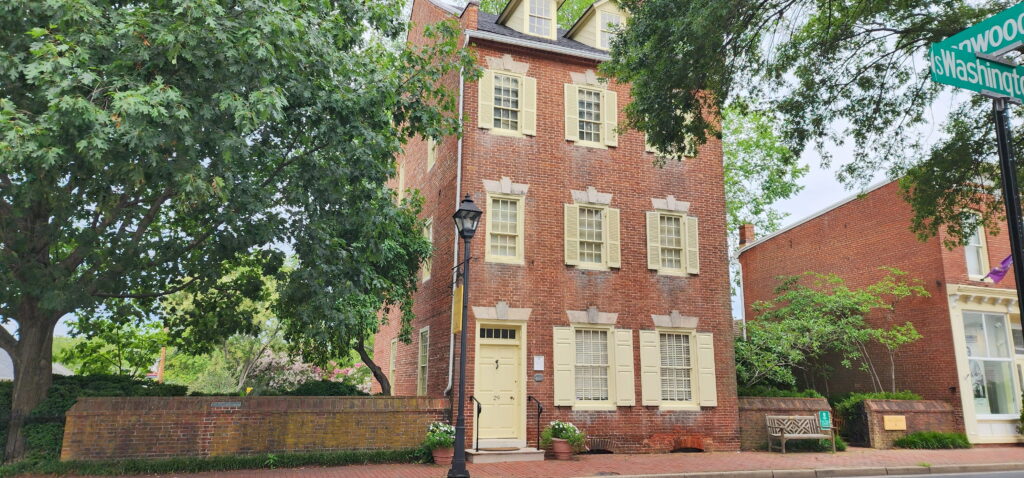
THE TALBOT HISTORICAL SOCIETY campus features a main building at 25 So. Washington St. in Easton, with historic collections and area history exhibits. Visitors are welcome to tour the adjacent brick James Neall House and Garden. In the garden, which is designed and maintained by the Talbot County Garden Club, you will discover the Mary Jenkins House (1783), the oldest frame house in Easton, and Joseph’s Cottage (1797), moved in from a nearby location and recently restored. Both brothers, Joseph and James, were cabinetmakers. James was also known to be a Quaker and early abolitionist.
THIRD HAVEN FRIENDS MEETING HOUSE is the oldest surviving frame house of worship in the country and a key landmark of Quaker influence on Maryland’s Eastern Shore. Measuring about 40 by 60 feet and constructed of cypress wood, Third Haven symbolizes not only America’s early religious freedom, but also the enduring Quaker traditions of simplicity and equality. In continuous use for more than 340 years, it remains an active worship center and community hub. It is listed in the National Register of Historic Places.
HARLEIGH FARM GARDENS AND GROUNDS: Since the early 1800s, Harleigh has been a celebration of landscape and legacy, with the house built in the telescope architectural style of its time. The estate’s pea-gravel paths wander past early dependencies—a smokehouse, summer kitchen and washhouse, farm offices and studio. The garage, a lively gathering place sporting two huge fireplaces, will offer visitors an exhibit of aerial images taken by photographer H. Robins Hollyday in the 1920s.
Harleigh’s current owners modeled their floral and kitchen gardens after Thomas Jefferson’s at Monticello. Ornamental gates transition from one vista to another, including a whimsical pergola draped in wisteria. A fairy-tale boathouse adorns the Trippe Creek shoreline, while meadows and wildlife habitat extend beyond. The formal garden, brimming with peonies and heritage roses, was designed by Rosalind de la Fontaine. “Hic Hortus Inclusus Edificatus Est 1922 AD”—“Here is the enclosed garden, built in 1922” is inscribed on its walls.
PLIMHIMMON’s original 600-acre parcel was granted in 1659. The mid-18th Century house was bought by Matthew Tilghman, Delegate to the Continental Congress, for his daughter Anna Maria. Following the death of her husband, Revolutionary War hero and George Washington’s aide-de-camp Col. Tench Tilghman, she lived at Plimhimmon for 50 years and hosted the Marquis de Lafayette here in 1824.
The historic central portion of the house features a polished walnut staircase, elegant arched doorways and decorative moldings. Renovations (2008-2015) enhanced period details with charcoal-gray baseboards, custom wallpaper hand-painted with Chesapeake flora and fauna, and modern amenities including geothermal HVAC and an elevator. Outbuildings include a carriage house, lofted garage and historic smokehouse, set amid 200 acres of farmland, fields and woodlands. The landscape is anchored by specimen trees—copper beech, ginkgo, magnolia, walnut, pecan, and a willow weeping over Town Creek—affirming Plimhimmon as one of Talbot County’s Georgian masterpieces.
WYE HOUSE is one of Maryland’s most historic homes and one of the few privately held National Historic Landmarks in the country. It is located along the Wye River on land acquired by Edward Lloyd in 1659. His descendants served as a Delegate to the Continental Congress, a Governor, a U.S. Congressman, and U.S. and State Senators. The current house was constructed between 1784 and 1790 by Edward Lloyd IV and is currently occupied by the 12th generation of the Lloyd family to live on the property.
The Palladian-style house is often referred to as the finest example of late 18th Century Palladian architecture in the United States. Many original furnishings and objects remain in the house. The 18th Century Orangery (greenhouse) predates the house and is the most complete surviving structure of its kind in the country. The property contains numerous early 19th Century outbuildings, including a stable, smoke house, dairy, carriage house, icehouse, and overseer’s house. The Lloyd family cemetery is located behind the Orangery, with its earliest grave dated 1684.
EMERSON POINT, a 220-acre retreat on the Miles River, blends timeless beauty with thoughtful preservation. Built in the 1930s in Georgian style upon the site of an earlier farmhouse, the estate once belonged to the Hambleton and Dawson families, rooted here since the 1700s. Recent renovations upgraded essential infrastructure and restored exquisite elements such as library paneling, mahogany doors and original shutters. Terraces and windows yield to scenic wetlands, sandy beach and magnificent trees.
Lined with cedars and cryptomeria, the drive reveals lustrous magnolias, Japanese zelkova, and an American beech allée. A row of oaks, grown from seedlings of the legendary Wye Oak, leads to the boathouse. Midway between house and water stands the “Wedding Tree” whose boughs have sheltered couples plighting their troth. A family cemetery and lore of Frederick Douglass’s visits infuse the estate with reverence, uniting architectural grace and lyrical landscape with our enduring human story.
On Tour, we hope that visitors will pause and take time to also experience the charm and history of the towns of OXFORD and ST. MICHAELS via brief narrated driving tours that highlight the citizens, sites and stories from important eras of America’s past. Exclusive tour access will be provided to all who purchase Tour tickets.